Sovereign AI
NVIDIA PAIR vs Xinity: Router or AI Control Plane?
NVIDIA has released a beta of the Personal AI Router, or PAIR. It connects the machines already sitting on your local network, Windows systems with RTX GPUs, DGX Spark, and recent Macs, and gives your applications a single local endpoint to send inference requests to. It works alongside Ollama and LM Studio. No internet connection is required to operate it. Prompts, files and agent context stay on the network.
It is worth paying attention to for a reason that has nothing to do with competition.
The argument about local AI is over
Two years ago, telling a European company to run its own models was a minority position. The default assumption was that serious AI meant an API call to a US hyperscaler, and that anything else was a hobbyist detour.
The largest AI hardware company in the world now ships a consumer application whose main selling point is that your data does not leave your network.
Local inference is no longer the thing that needs defending. That part of the conversation has moved on. What has not been solved, and what PAIR does not attempt to solve, is everything that happens once more than one person is involved.
What NVIDIA PAIR actually does
It is worth being precise, because the marketing language around local AI has become loose enough to make very different products sound identical.
PAIR answers one question: I have several machines with GPUs on this network, which one should handle this request?
That is a scheduling problem, and PAIR solves it cleanly. It discovers eligible machines, exposes one endpoint to the application, and sends each incoming request to a node that has capacity. NVIDIA is also clear about what it does not do. The devices stay separate systems working on parallel tasks. PAIR does not pool their memory into one large virtual GPU, and it does not split a single request across machines. If you have a 32 GB card, a 24 GB card and a Mac with 64 GB of unified memory, you do not get a 120 GB GPU. You get three places to send a request.
For a developer with idle hardware in the next room, that is genuinely useful. It turns dormant compute into working compute with no cabling, no rack, and no cluster engineering.
The question a regulated organisation asks instead
Now change the setting. A bank, a hospital, a law firm, a ministry. The hardware question is not the hard part. They already run their own infrastructure. The hard part is everything around the model:
Which employees and which applications are allowed to query which model
How that permission is tied to existing identity and directory systems
What record exists afterwards of which request was made, by whom, against which model
Which department's data touched which endpoint
What you hand a supervisory authority when they ask you to demonstrate any of the above
None of those are routing questions. Routing is about efficiency. These are questions about accountability, and they are the ones that decide whether an AI deployment in a regulated sector ever reaches production.
This is the layer Xinity builds. Not the model, and not the GPU. The layer around the model: deploy open weight models on your own servers, govern who is allowed to use them, and keep a record of what happened. An OpenAI-compatible endpoint so your existing applications do not need rewriting. Role-based access control and single sign-on so permissions come from the same place as every other permission in the organisation. Per-request observability and audit logging so the record exists before someone asks for it, not after.
Where the two products sit in the stack
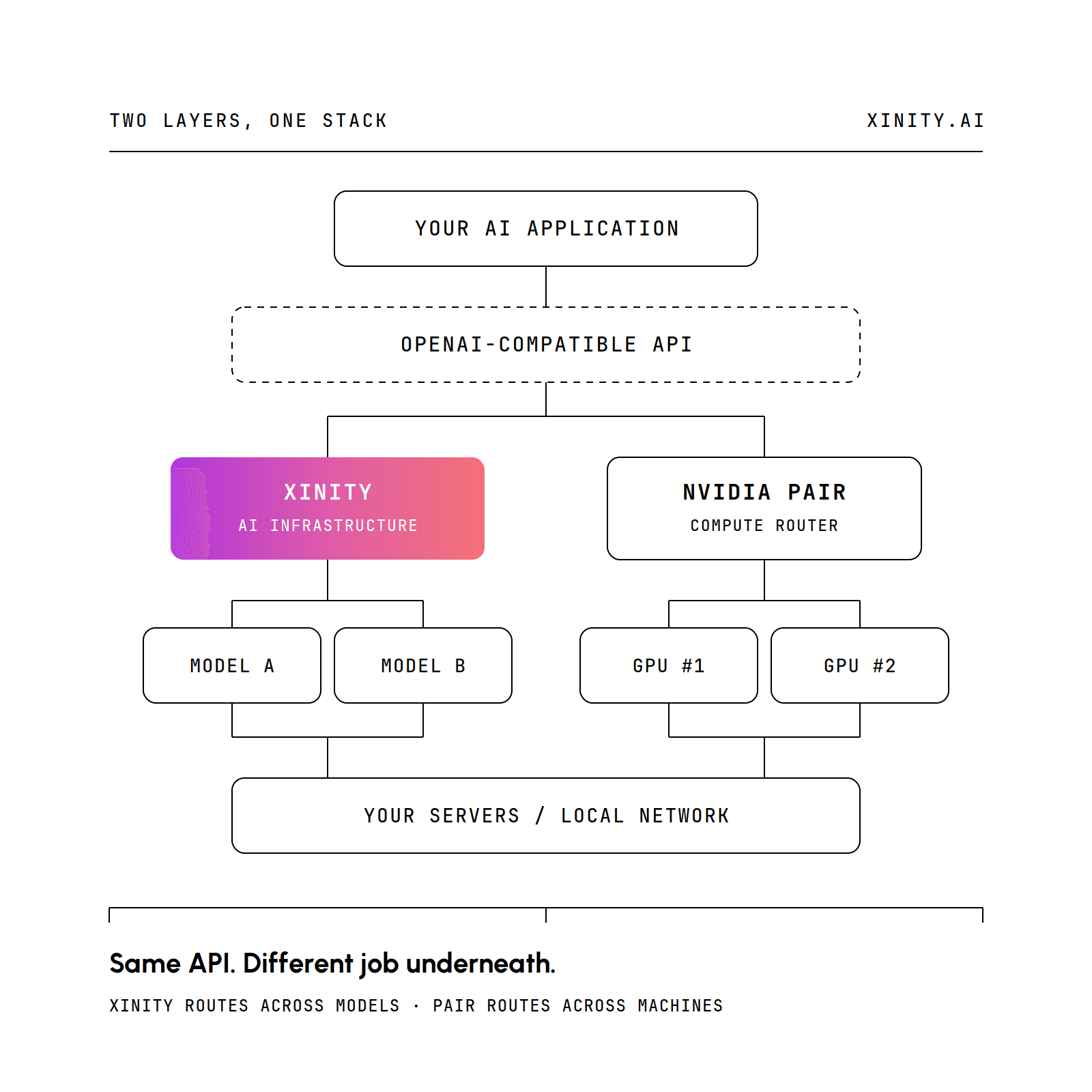
The clearest way to say it:
NVIDIA PAIR answers: how do I use all the AI compute I already have?
Xinity answers: how do we operate AI on our own infrastructure in a way we can defend to an auditor?
The first is a personal productivity question. The second is an institutional one. They sit at different heights in the same stack, which is why the comparison is interesting rather than adversarial. In principle a control plane sits above a compute router: governance and logging at the top, request distribution underneath. We have not tested that arrangement and we are not claiming it as a supported configuration. But architecturally, they are not competing for the same slot.
Why this matters for AI infrastructure planning in Europe
The lesson of PAIR is not that NVIDIA has entered a new market. It is that the premise has shifted. Keeping inference on your own hardware is now a mainstream, vendor-endorsed, consumer-grade expectation.
Which means the differentiator has moved. If everyone can run a model locally, the question is no longer whether your data stays put. It is whether you can prove who used it, what they asked, and under what authority.
That proof is not a feature you add later. It is an architectural property, or it is absent.
Sovereign by architecture, not by contract.
AI declaration: this article was drafted with AI assistance and reviewed, fact-checked and edited by the Xinity team before publication. All product claims about Xinity reflect shipped functionality. Statements about NVIDIA PAIR are taken from NVIDIA's own published product page and documentation.