AI
Understanding the AI Stack and Where Xinity Fits In
Most organizations adopting AI do not realize how many layers they are building on. Each layer is a dependency, a cost center and a control point. Map the layers and you can see what you actually depend on. You can also see where Xinity provides sovereignty.
The Five Layers of the AI Stack
Layer 1: Hardware Infrastructure
What it is: the physical computing power behind AI workloads. That means GPUs for parallel processing, AI accelerators, high-performance CPUs, memory, storage and networking.
Traditional control: Cloud providers own and operate massive data centers. Your workloads run on their hardware, in their facilities, under their physical control.
The dependency: You rent computing time but never own the infrastructure. Costs scale indefinitely with usage. You’re subject to availability, pricing changes, and service terms. Physical processing location is outside your control.
Layer 2: System Software & Runtime
What it is: the software that manages your hardware. Operating systems, container orchestration such as Docker and Kubernetes, GPU drivers, CUDA libraries, resource scheduling and security layers.
Traditional control: Cloud providers configure and maintain these systems. You get limited access through APIs. Updates, patches, and configurations are managed externally.
The dependency: Limited visibility into system configuration. Cannot customize low-level optimizations. Dependent on provider’s security practices and system-level compliance.
Layer 3: AI Model Serving & Orchestration
What it is: the layer that loads models, handles requests and manages inference. It covers model start-up, request routing, GPU allocation, caching, tuning, API gateways and monitoring.
Traditional control: Cloud AI providers package this as a black box. You send requests, they return results. No visibility into how models are loaded, cached, or optimized.
The dependency: Cannot optimize for your specific workload patterns. No custom routing logic. Limited to provider’s supported models. Opaque performance characteristics.
🎯 This Is Where Xinity Operates
Xinity provides the orchestration layer between your applications and AI models, giving you:
Complete control over model serving infrastructure
Intelligent routing across multiple models and GPUs
Custom optimization for your workload patterns
Full visibility into performance and resource usage
OpenAI-compatible APIs for seamless integration
Layer 4: AI Models
What it is: the neural networks themselves. Foundation models such as LLMs and vision models, fine-tuned models, specialized domain models, embeddings and multi-modal models.
Traditional control: Cloud providers offer access to proprietary models you can use but don’t own. Model weights and architectures are often closed. Fine-tuning may be limited or expensive.
The dependency: Cannot inspect model internals. Limited customization. Model updates on provider’s schedule. Pricing tied to model sophistication.
How Xinity addresses this:
Deploy any open-source model you choose
Run custom fine-tuned models on your data
Full ownership of model weights and training data
Freedom to experiment with cutting-edge open models
No restrictions on modification or specialization
Layer 5: Applications & Interfaces
What it is: the apps and APIs your users actually touch. Chat interfaces, document processing, code generation, customer service bots, analysis tools and your own business applications.
Traditional control: You build the application, but it’s tightly coupled to specific cloud AI APIs. Switching providers means rewriting code.
How Xinity addresses this:
OpenAI-compatible API means your applications work unchanged
Drop-in replacement by changing base URL and API key
No vendor lock-in at the application layer
Freedom to switch or multi-source models
The Stack Comparison
Traditional Cloud AI: Hidden Dependencies
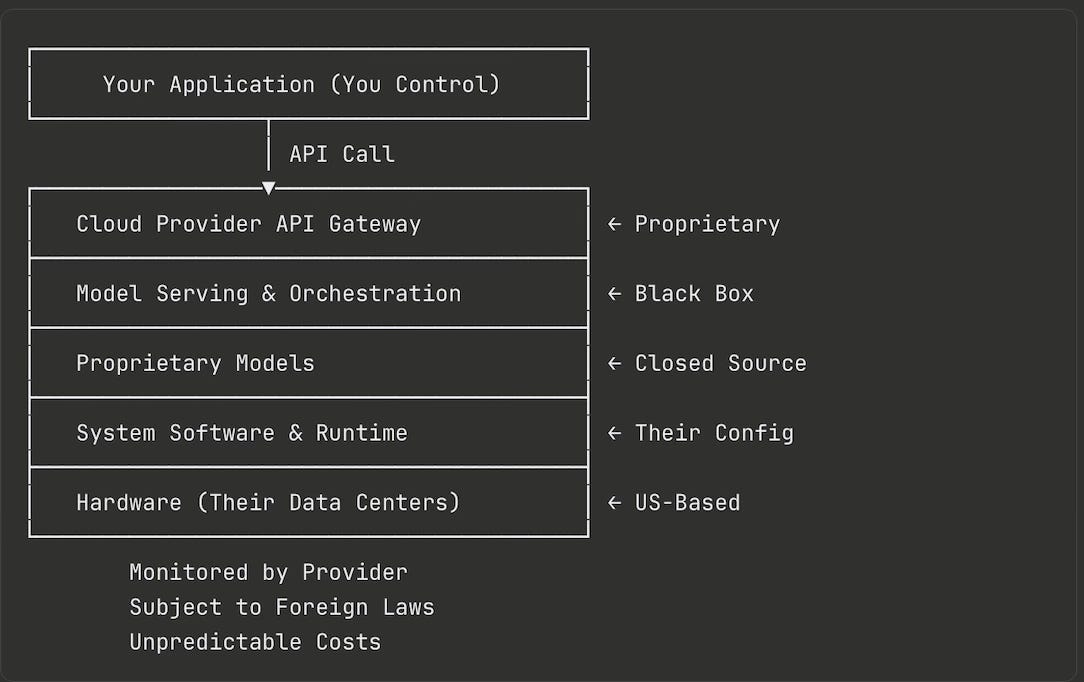
You control: Your application code
You don’t control: Everything else—monitoring, jurisdiction, costs, configuration
Xinity Sovereign AI Stack: Full Control
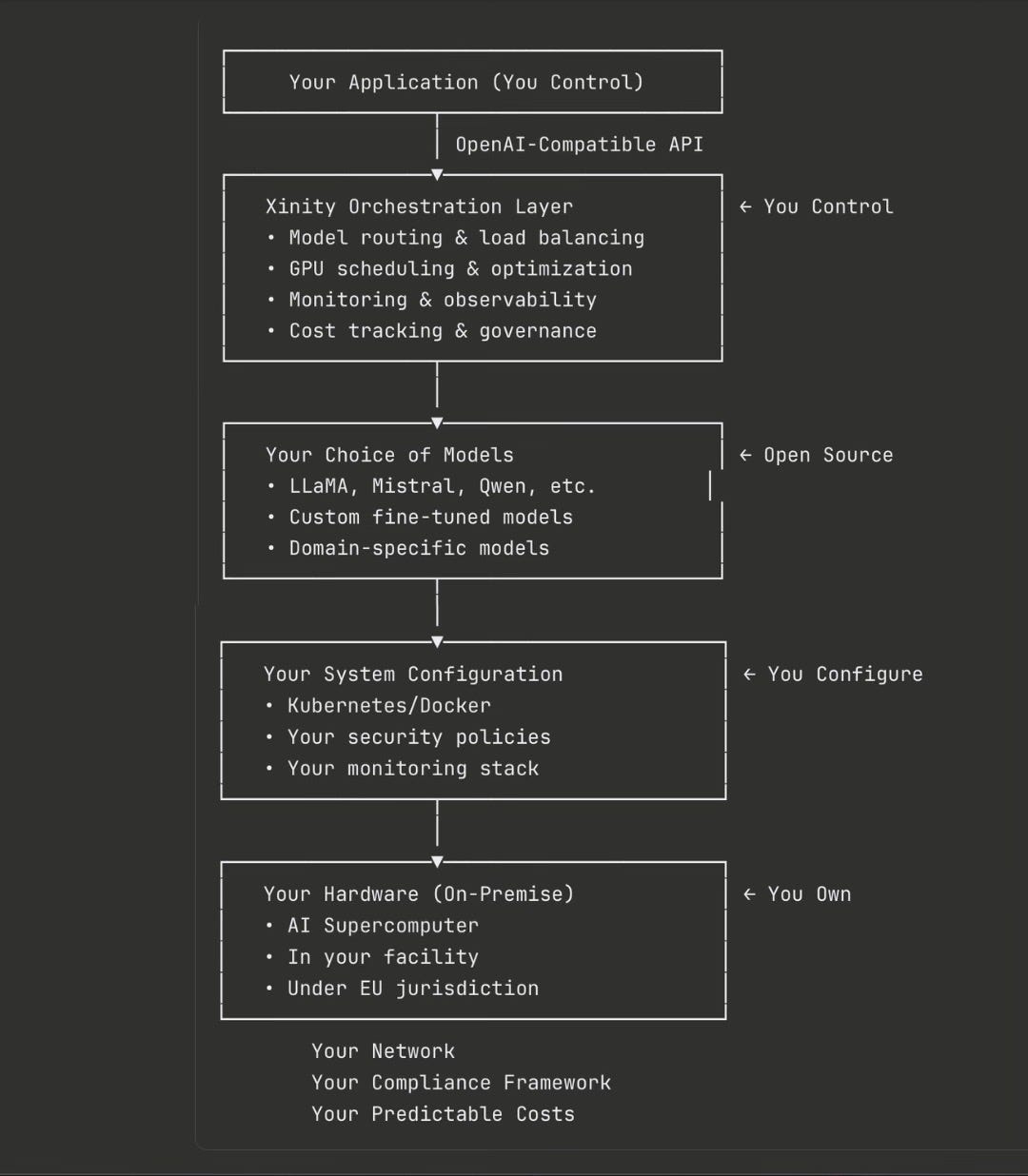
You control: Everything from hardware up
What Xinity provides: The intelligent orchestration layer that makes it all work seamlessly
The Problem Xinity Solves
The False Choice
Most organizations face two bad options:
Option A: Cloud AI Services
✅ Easy to use with simple APIs
✅ No infrastructure management
❌ Data leaves your control
❌ Unpredictable, scaling costs
❌ Vendor lock-in
❌ Subject to foreign jurisdiction
Option B: Build Everything Yourself
✅ Full control over infrastructure
✅ Data stays on-premise
❌ Requires 12+ months of development
❌ Need deep ML engineering expertise
❌ Complex model serving infrastructure
❌ Ongoing maintenance burden
Xinity: The Third Way
✅ Cloud-like simplicity with OpenAI-compatible APIs
✅ Full data sovereignty on your hardware
✅ Production-ready in days, not months
✅ No ML engineering expertise required
✅ Predictable infrastructure-based costs
✅ European jurisdiction and GDPR compliance
What Makes Xinity’s Orchestration Essential
1. Intelligent Model Routing
Not all queries need your most powerful model. Xinity routes requests based on query complexity, required quality, available GPU resources, cost constraints, and latency requirements.
Real impact: Simple factual queries route to smaller, faster models while complex reasoning tasks use your most capable model—optimizing both performance and cost.
2. GPU Resource Optimization
GPUs are expensive. Xinity maximizes value through on-demand model loading, request batching, workload-based allocation, and prevention of resource contention.
Real impact: Run 3-5x more inference throughput on the same hardware compared to naive implementations.
3. Production-Grade Reliability
Enterprise AI needs enterprise reliability: automatic failover, health monitoring with automatic recovery, request queuing during high load, and graceful degradation strategies.
Real impact: Your applications stay responsive even when individual components fail.
4. Observability & Governance
Comprehensive visibility with request-level logging and tracing, cost attribution by team or project, performance metrics and bottleneck identification, and audit trails for compliance.
Real impact: Know exactly where AI resources are going and prove compliance to auditors.
5. Zero-Friction Migration
OpenAI-compatible API means changing two lines of code (base URL and API key), keeping existing prompt engineering, maintaining current workflows, and requiring no team training.
Real impact: Migrate production applications in hours, not months.
Use Cases: Where Xinity Matters Most
Multi-Team Enterprises
Challenge: Different teams using AI independently, no cost visibility, resource conflicts
Xinity Solution: Centralized control plane, per-team quotas and policies, shared GPU infrastructure with fair scheduling, unified billing and cost allocation
Regulated Industries
Challenge: Need AI capabilities but cannot send data to cloud providers due to compliance
Xinity Solution: Complete data residency on your hardware, full audit trails, compliance-ready (GDPR, sector-specific regulations), explainable routing and decision-making
Cost-Sensitive Deployments
Challenge: Cloud AI costs spiraling as usage grows, need cost predictability
Xinity Solution: Infrastructure-based pricing (not per-token), intelligent routing to minimize compute, complete cost visibility, 70-90% cost reduction vs. cloud
Custom Model Deployments
Challenge: Need to run fine-tuned or domain-specific models unavailable from cloud providers
Xinity Solution: Deploy any open-source model, run custom fine-tuned models, A/B test multiple versions, gradual rollout of updates
Why the Orchestration Layer Matters
Running AI models on your own hardware isn’t enough for sovereign AI. You need:
An intelligent layer that makes optimal use of your resources
Production-grade reliability that enterprises require
Developer-friendly APIs that enable fast migration
Observability and governance for compliance and optimization
This orchestration layer is complex to build—it took cloud providers years to develop theirs. Xinity brings that same sophistication to on-premise deployments, making sovereign AI practical for organizations that need control without complexity.
Xinity doesn’t just give you infrastructure. It gives you the missing piece that makes sovereign AI actually work in production.
Ready to See Xinity in Action?
Learn how Xinity can bring cloud-like AI capabilities to your on-premise infrastructure.